


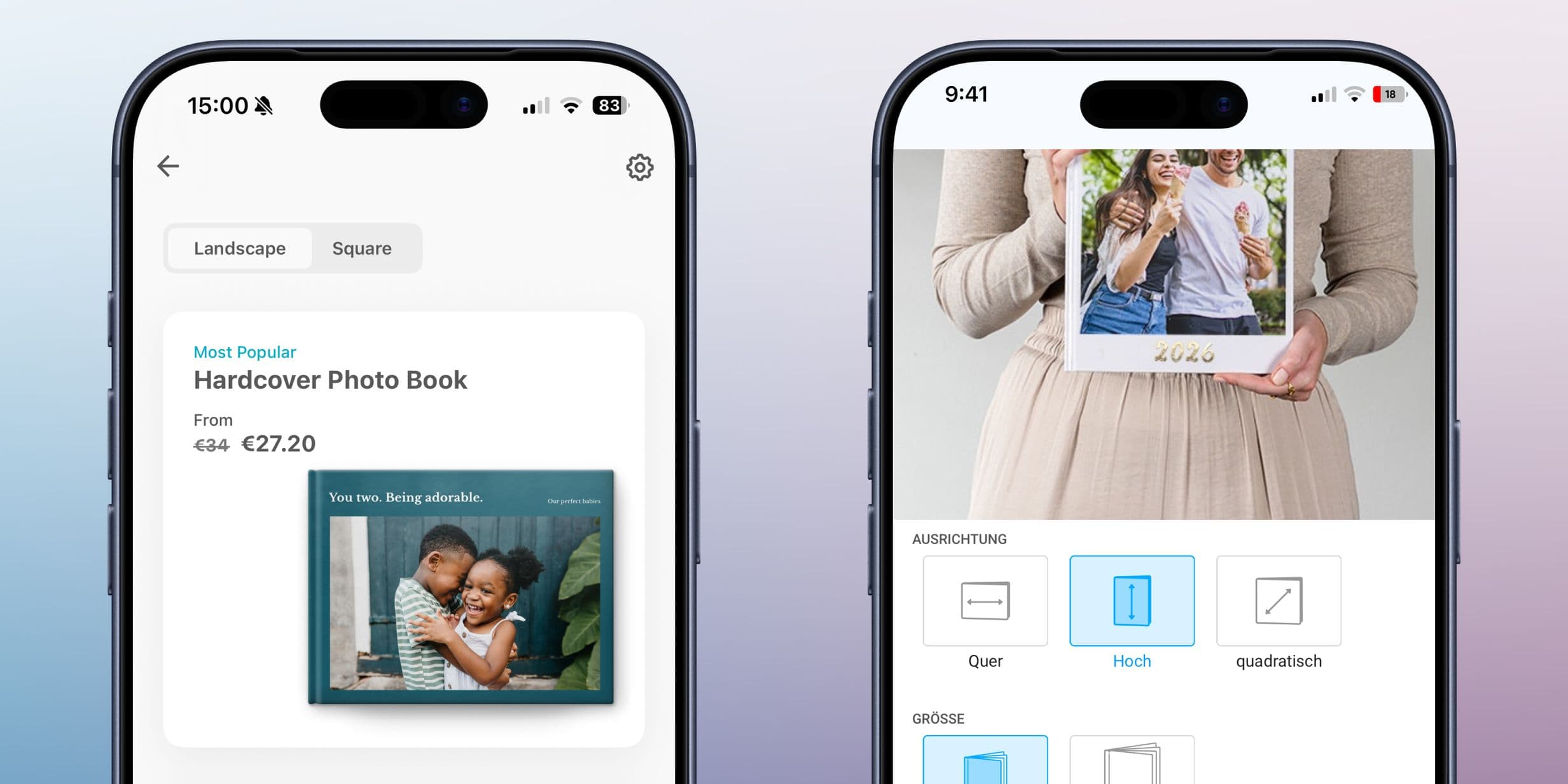
Popsa operates globally, including Germany. This article compares Popsa with Pixum – one of Germany’s most established photo book services – for customers ordering from that location.
When it comes to designing a photo book, choosing between Popsa and Pixum depends on what you value most in the process. Popsa is a strong choice if you want a fast, mobile-first creation experience with transparent post-purchase policies and strong environmental credentials. Its lower per-page cost, Facebook integration, and B Corp certification make it a clear fit if you value flexibility, sustainability and peace of mind. Pixum has a lower starting price for a large hardcover book, faster express delivery and phone support, if those factors are priorities for you.
Popsa | Cheerz | |
|---|---|---|
| iOS app available | ✓ | ✓ |
| Android app available | ✓ | ✓ |
| Steps to create a photo book | 10 steps | 10 steps |
| Paper weight | 200gsm | 170 gsm |
| Minimum number of pages | 20 | 24 |
| Base price* | €49 | €38.80 |
| Additional page cost | €0.80** | €0.99*** |
| Quickest delivery (from) | 4-7 working days (€39.99) | 3-4 working days (€9.99) |
| Cheapest delivery option | €8.49 | €4.99 |
| Satisfaction guarantee | ✓ | ✗ |
| Reprint policy | ✓ | ✗ |
| Refund policy | ✓ | ✗ |
| Trustpilot rating (reviews) | 4.4 (120k) | 4.4 (32k) |
| App Store rating | 4,8 | 4.7 |
| Google Play rating | 4.6 | 4.7 |
| B-Corp certified | ✓ | ✗ |
What Popsa offers
Popsa is best if you:
want to pay less per additional page when building a longer photo book
prefer a clearly stated reprint and refund policy before you order
value the fact your order is produced locally where possible
want a mobile creation experience with the fewest extra sign-in or download steps
prefer importing photos directly from Facebook without downloading files first
want a rush delivery option when ordering close to a deadline
value purchasing from a certified B Corp with independently verified sustainability credentials
prefer biodegradable and recycled packaging
want AI caption suggestions throughout the book, not just on the cover
What Pixum offers
Pixum may be a better fit if you:
want a lower starting price for a large landscape hardcover photo book
prefer to speak to customer support by phone
want the fastest available delivery at the lowest express delivery cost
prefer a wider range of paper weights, including heavier options
want a portrait photo book format
prefer working in dedicated desktop software
want a layflat binding upgrade at a lower additional cost
prefer a higher Trustpilot score based on verified customer reviews
Getting the job done
Both Popsa and Pixum offer native iOS and Android apps, browser-based creation and cross-device workflows, so you can begin and complete a project on whichever device suits you. Popsa supports offline editing within its standard creation experience, while Pixum’s offline capability is tied to its separate desktop software. Popsa also connects directly to Facebook, giving you an additional way to access your photos without downloading images first.
If you want to get started quickly and keep going whenever you have a spare moment – on your phone, at your laptop or somewhere without a reliable connection – having fewer obstacles along the way makes it more likely you’ll actually finish the book. Popsa’s direct integrations and offline support are designed with exactly that in mind. Pixum’s creation flow involves slightly fewer steps overall, which may suit those who prefer a more structured, upfront approach.
Creative outcome
Both services offer softcover, hardcover, layflat and booklet photo book formats across landscape and square sizes, with automatic and manual layout options, AI-assisted cropping, full-bleed pages, captions and page rearrangement.
Pixum also offers portrait format books, paper weights up to 382gsm, and clipart, frames and masks – useful if format variety or decorative personalisation matter to you.
Popsa uses 200gsm paper as standard and offers AI-generated caption suggestions throughout the book rather than only on the cover.
If you’re creating a keepsake or a gift, the formats, paper weights and personalisation options will shape how the finished book looks and feels. Paper weight, in particular, makes a noticeable difference to how substantial the finished product feels in your hands.
Speed and reliability
Both Popsa and Pixum offer standard, express and tracked delivery, and both will get your book to you reliably. Pixum’s fastest delivery option has a shorter lead time than Popsa’s, and its lowest-cost delivery option is also cheaper. Popsa offers a rush delivery option for situations where you’re ordering close to a deadline. If timing is non-negotiable, it’s worth comparing the fastest available options and costs before you commit.
Price clarity and fairness
Pixum’s starting price for a comparable large landscape hardcover photo book is lower than Popsa’s standard non-sale price. But as your book grows, the picture shifts. Popsa charges less per additional page and has a lower minimum page count, making its pricing more predictable for longer or evolving projects. Pixum’s layflat binding upgrade, gloss paper upgrade and presentation box are each priced lower than Popsa’s equivalents; Popsa’s foil lettering personalisation is priced lower than Pixum’s.
The headline price is rarely the whole story. Depending on how long your book is and which upgrades you choose, the total cost can shift considerably – so it’s worth pricing up your specific book on both services before deciding.
Control without complexity
Both Popsa and Pixum provide browser-based creation tools, so you can work on a larger screen without downloading software, and both support page rearrangement during creation. Pixum also offers dedicated desktop software for those who prefer an installed-application workflow. If you’re working in a browser or on your phone, both services offer comparable tools – the choice here comes down to whether desktop software is something you’d actually use.
Trust and reassurance
Ordering a printed product sight unseen carries risk, and both brands recognise this. Both offer satisfaction guarantees and online help centres. Pixum holds a Trustpilot rating of 4.7 from around 49,000 reviews; Popsa has a 4.4 rating from approximately 120,000 reviews.
Popsa has a slightly higher App Store rating, while Pixum’s Google Play rating is marginally higher. Popsa publishes clearly defined reprint and refund policies; Pixum handles post-purchase issues on a case-by-case basis through customer service, and also offers telephone support alongside live messaging.
Because photo books are personalised products, knowing what happens if something goes wrong before you order can give you peace of mind. Popsa’s published reprint and refund policy means you can read the terms rather than relying on a case-by-case outcome.
Values and responsibility
For customers who consider the broader impact of their purchases, both companies offset carbon emissions, use FSC-certified paper and publish sustainability commitments. Popsa goes further: it is a certified B Corporation, having undergone independent assessment of its social and environmental business practices. It states that it uses recycled and biodegradable packaging and produces orders locally where possible. Pixum operates multiple European production facilities but does not provide the same level of detail on packaging or local production.
If buying from a company whose environmental practices have been independently verified matters to you, Popsa’s B Corp certification offers a level of assurance that goes beyond a brand’s own sustainability claims.
*Base price for a 20-page large landscape hardcover photo book). **Popsa additional pages are priced per single page. ***Pixum additional pages are priced per four-pages – single pages cannot be added individually.
Téléchargez l'application
Replongez dans vos souvenirs en toute simplicité grâce à des fonctionnalités exclusives comme la reconnaissance faciale et les albums intelligents.


Articles connexes
&w=96&q=75)
&w=96&q=75)
Nathan Cook
Écrivain Popsa
20 janv. 2026∙7 min
&w=96&q=75)
Milly Kenny-Ryder
Rédactrice voyage et photographe
17 mars 2026∙4 min


 États-Unis