

Historier
Heritage Heroes: the beauty of textile design with Rosanna Falconer
From discovering her visual language through the ancient craft of block printing to the joy of working alongside artisans across cultures

24. juni 2026∙6 min
Historier
From discovering her visual language through the ancient craft of block printing to the joy of working alongside artisans across cultures
24. juni 2026∙6 min
Heritage Heroes celebrates the artisans preserving centuries-old crafts and traditions. In this series, we seek out the workshops worth the detour, the experiences that capture the spirit of a destination and the keepsakes you’ll treasure long after the journey ends.
Five hours southwest of Delhi, Jaipur draws travellers with its striking terracotta facades, spice-scented bazaars and royal history. Yet beyond the palaces and pink-hued streets exists the hub of India's creative scene, where the art of block printing has been practised for centuries. In workshops across the capital of Rajasthan, artisans press hand-carved wooden blocks onto cotton and silk, building intricate designs with extraordinary precision.

Rosanna Falconer block printing. Photo: Saurabh Srivastava
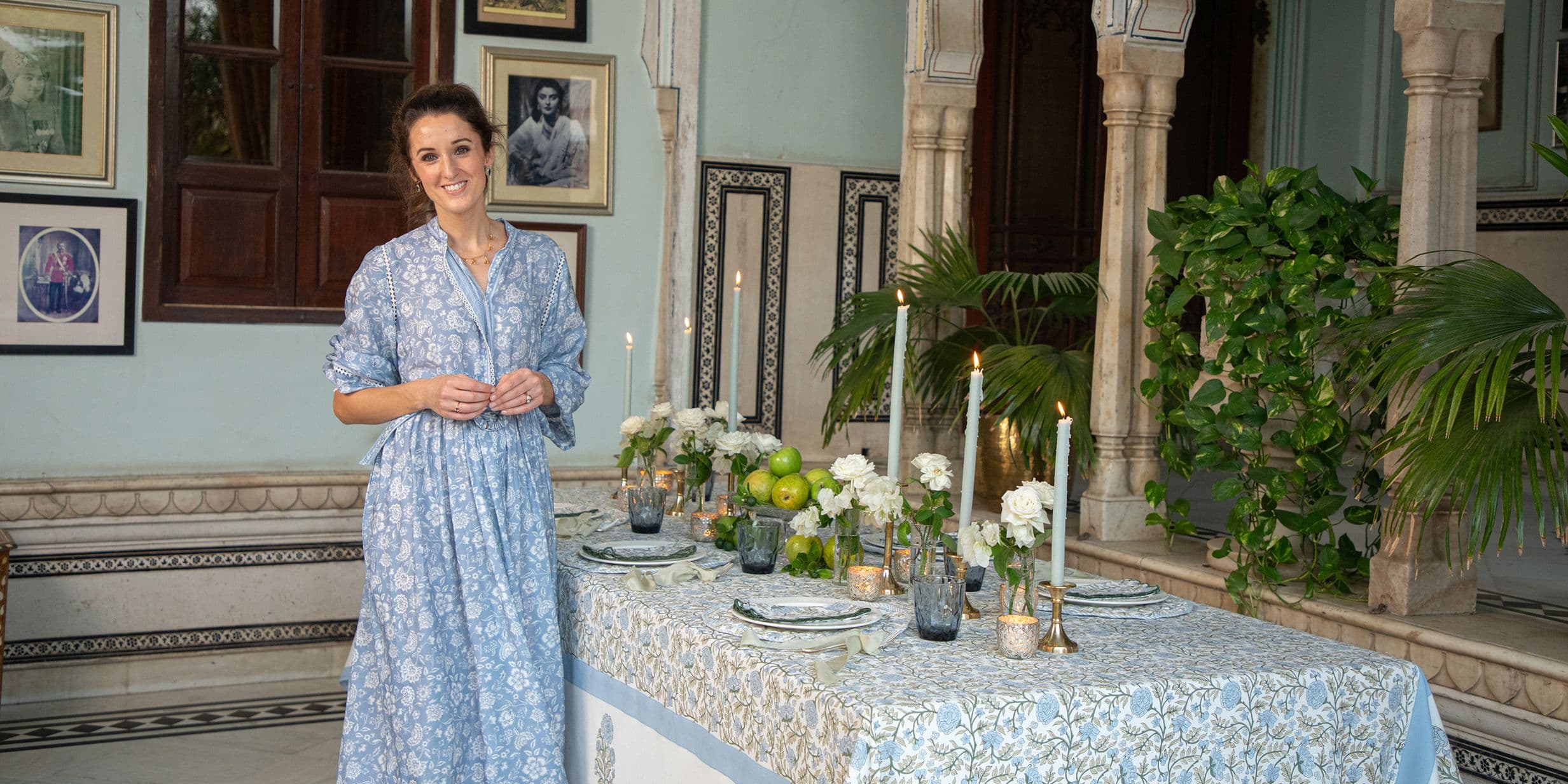
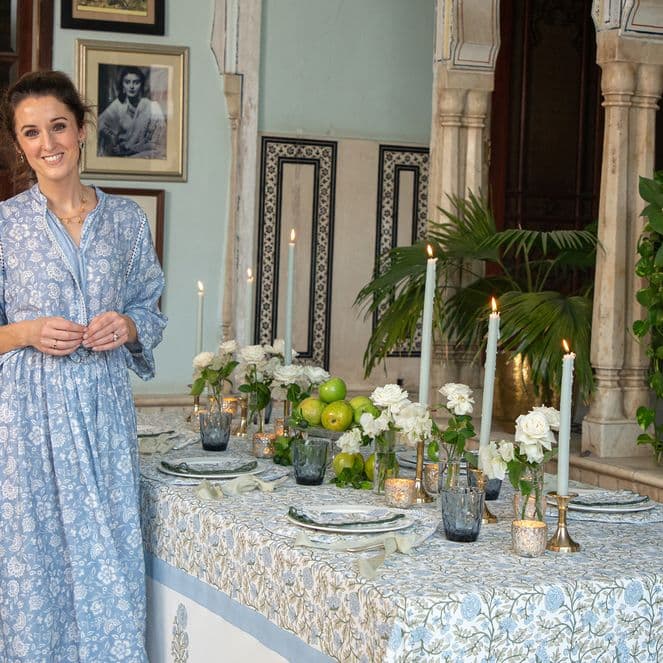
Rosanna Falconer, a textile designer based between London and Jaipur, swapped her career in fashion for the craft, producing block-printed linens, quilts and cushion covers inspired by her childhood in the English countryside. “Block printing is a medium that allows contemporary ideas to take shape while remaining rooted in place, without being confined by tradition,” she says. “I love the way the small irregularities reveal the human touch – it’s a reminder that something tangible has been made slowly, and with care.”
There wasn’t one defining moment but a gradual shift in perspective. In Jaipur, block printing is part of everyday life, whether in the vivid Sanganeri prints wrapped around bundles of marigolds at the phool mandi [flower market], or lengths of freshly printed fabric drying from the verandahs in the old city.
I was interested in how my own work – soft watercolours and floral drawings – could exist within a craft that is so precise. Working with local craftspeople, I learned that block printing didn’t flatten the delicacy of hand-painting but gave it another dimension. The slight irregularities and layered colours create a richness and character that mechanical printing can’t reproduce.

Quilt by Rosanna Falconer
Shivina Kumari Singh – the mother of a close friend – has had a profound influence on my designs. She has an exceptional knowledge of block printing and how it can be applied in new ways, having consulted for luxury brands across Europe and India for decades. We share a love of whimsical prints and colour, and she has an instinctive ability to identify what isn’t working before I can articulate it myself. She also introduced me to the family workshop that now produces my collections. Braj, who leads the workshop, is succinct and exacting in his advice.

Cushion cover by Rosanna Falconer
It has made me more open and instinctive in my approach to creativity. Jaipur, in particular, has taught me to let go of rigid timelines – things often come together at the last minute, but they do come together, and that requires a certain trust in the process.
London brings a different kind of discipline: structure, pace and clarity of execution. Moving between the two has allowed me to hold both approaches at once – a respect for process and precision, balanced with a willingness to let things evolve more organically. I grew up in the Cotswolds, and my parents still live in the same house – it feels almost like a member of the family. The landscape there is deeply familiar to me and continues to inform my visual language. Those English florals, that softness and sense of place, are something I carry into my work in Jaipur.
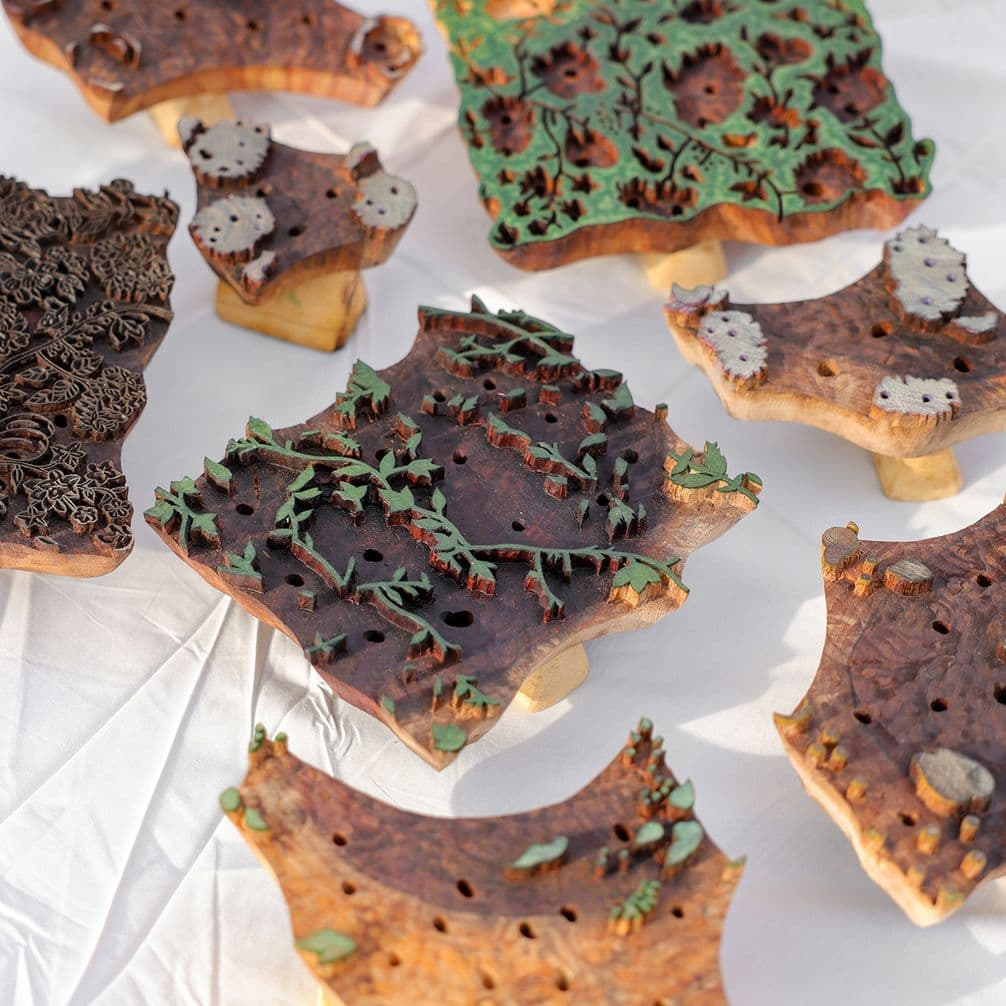
Blocks used for printing. Photo: Saurabh Srivastava
As an interior designer, I’m conscious of both the handmade and the machine-made, and the role each plays. Block-printed textiles require a more considered approach – sunlight softens the colours and they require delicate laundering – but that is part of what you are choosing when you work with them.
For me, keeping a craft like block printing alive is not about resisting progress but about preserving a different rhythm of production. It carries the hand of the maker – the slight irregularities, the layering of colour, the time embedded in each piece – all of which bring a depth that cannot be replicated mechanically. There is a social dimension that feels increasingly important. These crafts support creative communities and ensure that knowledge passed down through generations continues to have value, relevance and a place in contemporary design.
Alongside my design work, I run small creative workshops in Jaipur for students from Vimukti Sanstha, a non-profit school that provides education and career opportunities for young people from underprivileged backgrounds. The sessions are intentionally hands-on – from block printing to decorative painting – and are designed to build confidence as much as creative skill. The relationship, however, extends beyond the workshops, with a portion of annual profits, as well as income from ticketed events, donated to support the organisation.
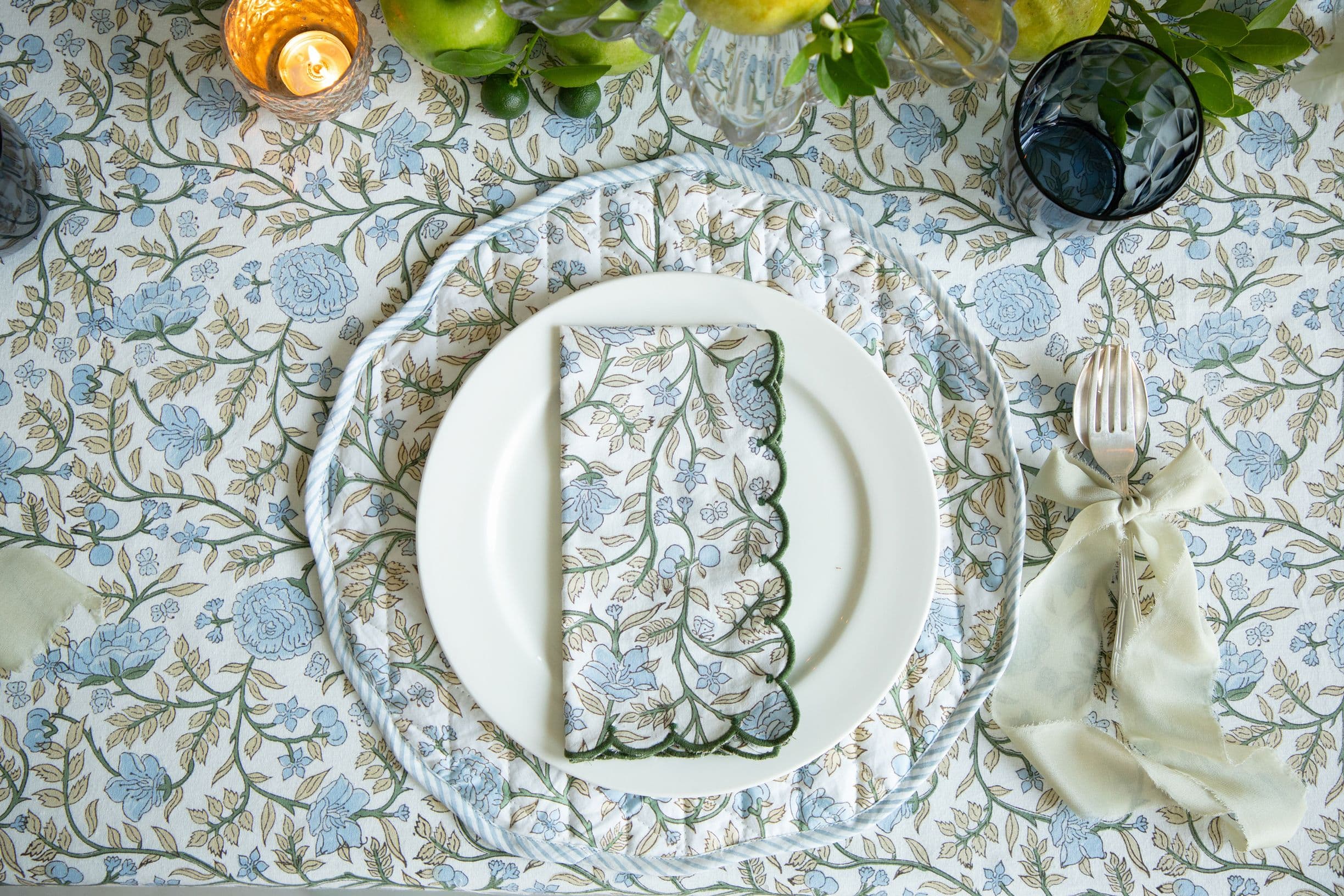
Table linens by Rosanna Falconer
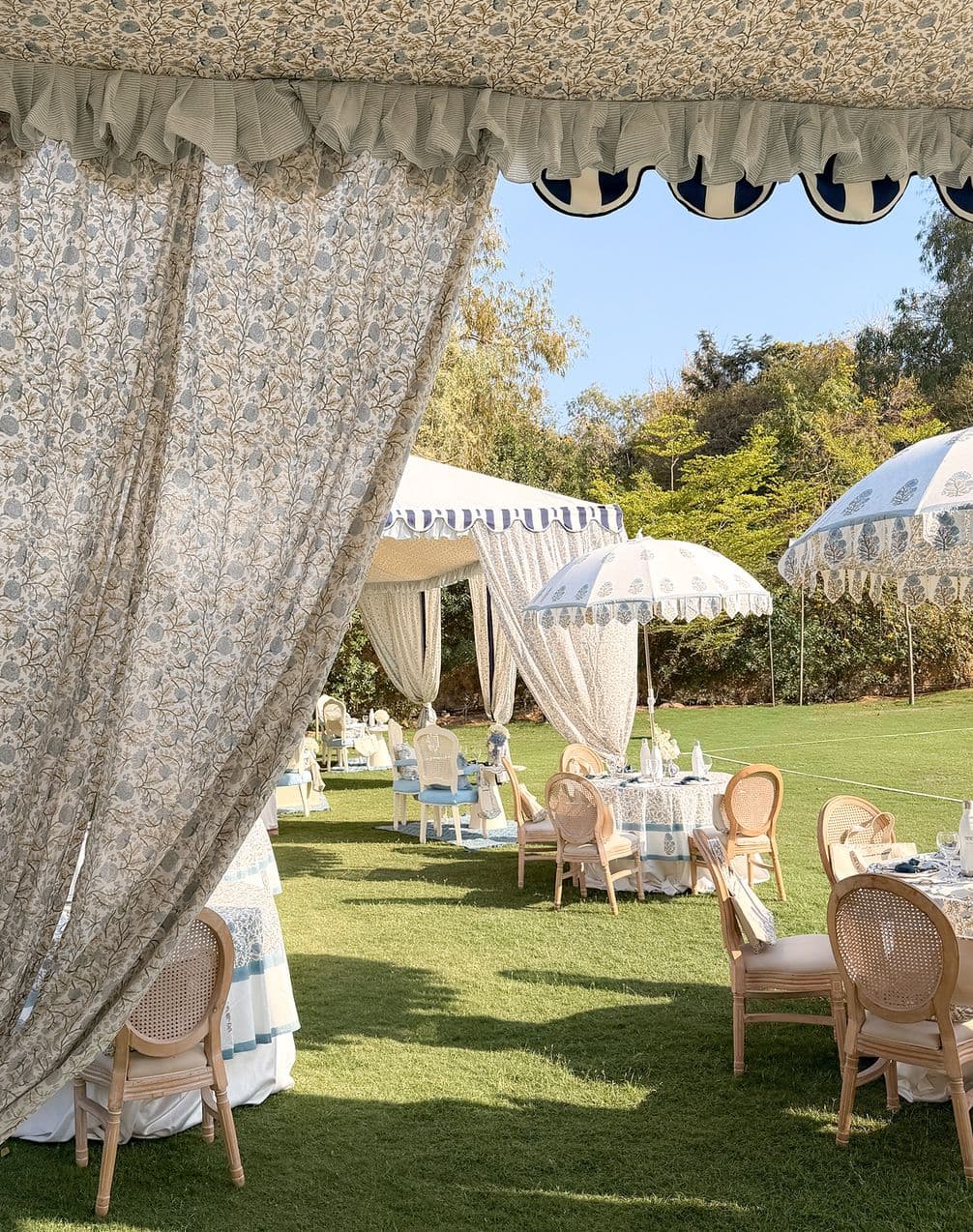
A private afternoon tea at Rambagh Palace in Jaipur for Chase Sapphire Reserve featuring Rosanna’s Rose Orchard print
A private afternoon tea at Rambagh Palace in Jaipur for Chase Sapphire Reserve, held on the eve of Holi. My Rose Orchard print was applied across the entire setting – as curtains, and even lining the ceiling – creating a fully immersive environment. It felt like a milestone to bring my work into such a regal space, with complete creative freedom. The timing was integral. The idea was to create something calm and considered before the intensity of colour that Holi brings, using a palette of soft blues, garden greens and the brand’s signature sapphire.
&w=3840&q=75)
Rosanna’s new Jaipur Blossom collection
&w=3840&q=75)
&w=3840&q=75)
Jaipur Blossom is the most detailed and layered print in my collection to date. It began with a drawing of a blue pottery vase filled with a garden bouquet – roses in bloom, hydrangeas, pear blossom and tiny wren birds woven throughout. The central motif, or butta, sits at intervals across the design, while the same flora expands into a corresponding jaal – a lattice of interconnecting stems and leaves that gives the print its sense of movement and abundance.
Joy, first and foremost. Whether it’s a table laid for dinner, a sofa layered with cushions or a bed dressed with a quilt, I hope a space feels inviting, lived-in and quietly celebratory in its everyday moments. And beyond that, an appreciation for the craftsmanship behind each piece.
Shop the collection at rosannafalconer.com
Finn minnene dine raskere med eksklusive funksjoner som ansiktsgjenkjenning og smarte album.


&w=96&q=75)
16. juli 2026∙7 min
&w=96&q=75)
29. juli 2026∙6 min
&w=96&q=75)
23. apr. 2026∙6 min


 SUA
SUA