Stories

Memory Architects: the digital artist – Harry Yeff

How AI, sound and performance converge to question what we keep, what we lose and how our memories live on in digital form

Memory Architects: the digital artist – Harry Yeff

Artikel overblik

  • Harry Yeff explores memory as something reconstructed – using AI, voice and performance to blur the boundary between human presence and data.

  • His work reframes sound as a lasting artefact – transforming voices into physical forms that honour identity, loss and emotional connection.

  • Through projects like Voice Gems, he reveals a growing desire for new rituals – ways to preserve, hold and meaningfully engage with memory in the digital age.

For this edition of Memory Architects we spotlight Harry Yeff, a digital artist and technologist whose work merges artificial intelligence, sound and performance to explore how memory, identity and communication evolve in the digital age. Also known by his artist name Reeps One, Harry investigates how technology extends human expression – capturing and reinterpreting memory through data, voice and digital consciousness.

In Harry’s work, memory becomes more than recollection – it is reconstruction. By training AI systems on his own voice and performance patterns, he challenges the boundary between human and machine memory – asking what is preserved, what is transformed and what is lost when we hand parts of ourselves to technology. His installations and performances are both deeply personal and radically futuristic, offering a mirror to how our memories might live on in new, digital forms.

Reeps100 and Trung Bao

How did your creative journey begin – and what first drew you to exploring the relationship between sound, memory and human expression?

I grew up neurodivergent on a council estate in east London. Before I knew the term ADD, I understood that my mind worked in extremes. I struggled with conventional focus but I felt effortless passion when something was new. Because my parents couldn’t afford to rent the instruments I wanted to learn, I started to practise with my voice. The deeper I went – not into singing but into sound-making, vocal technique and global vocal traditions – the more I saw that the voice, despite its physical limitations, is infinite in its own way.

What sound or piece of music instantly takes you back to a specific moment in your life?

The reverb inside concrete stairwells. It reminds me of my council estate block. I spent years walking up and down those stairs, using the space as my rehearsal room. I must have practiced thousands of times, learning how my voice would bounce and bend in that echo. That sound is still emotional for me. It is where I learned control, discipline and escape, long before I had studios or equipment. Whenever I hear that kind of reverb now, it takes me straight back there. I still love that sound.

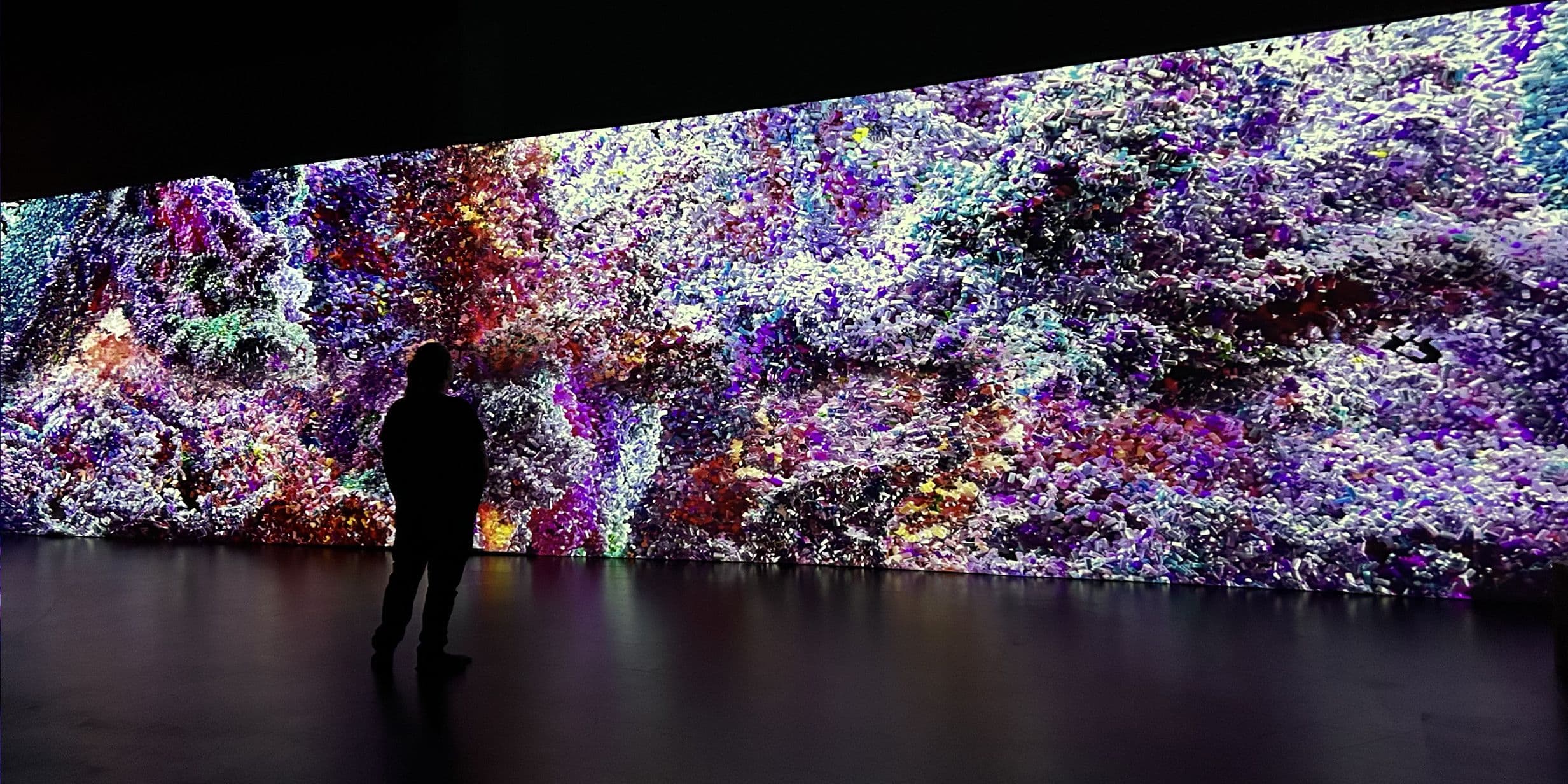
Harry Yeff with his work

R100 11Labs Agentic Voicing Nature Glacier

work by Harry Yeff depicting a glacier

R100 11Labs Agentic Voicing Nature Glacier

Many people know you first as Reeps One. How did that early chapter of your career evolve into your current practice, where you collaborate with AI and explore digital consciousness?

Being Reeps One gave me everything I have today. Looking back, it still feels like a miracle that a kid from Walthamstow, driven by obsession, became a key figure in how beatboxing evolved. But the truth is, I never fully fitted into the culture. My musical references were grime, early dubstep and IDM – artists like Aphex Twin. I was often described as an alien within the scene because I was more interested in pushing the voice into new territory than winning battles. Despite that, I became a double UK Champion and reached more than 100 million views online. 

Then, about eight years ago, I stepped away from music. I had stopped feeling novelty and inspiration. Soon after, University College London contacted me to take part in a neurological voice study because of my unusual level of vocal control. That experience opened an entirely new world. Through that research, I realised I could learn about the voice in ways I never could as just a musician. It was the moment I committed to exploring how the human voice can become art, and how technology can change the way we understand it.

work by Harry Yeff, also known as Reeps One

Harry Yeff live at the V&A

work by Harry Yeff, also known as Reeps One

The Collective Voice

The Voice Gems project transforms voice into a lasting, physical artefact. What inspired you to turn sound – something fleeting – into something permanent and visual?

I’d created a sculpture from the laughter between two people in love that was designed to replace the traditional diamond engagement ring. Their shared laughter became the precious material. That experience taught me something important. When you can see or physically hold a voice, you hear it in a new way. It becomes more than sound. It becomes a presence.

That realisation led me to found Voice Gems with Trung Bao. Voice Gems began with very high-profile voices – Jane Goodall, Ai Weiwei, leaders, thinkers, iconic cultural figures. The intention was to show that the human voice could be something worthy of being sculpted and preserved.

After the first wave of global press, something unexpected happened. We began receiving messages from people who had voice notes from loved ones who had passed away. That changed everything. It revealed something profound. People are yearning for new rituals. They do not just want to store audio on a cold device. They want a way to honour it, to hold it, to feel it again.

work by Harry Yeff, also known as Reeps One

White Voice Gem Exhibition

When working with someone’s voice in Voice Gems, you’re essentially encoding their presence into data. How do you balance the technical precision with the emotional weight of that process?

The emotional weight always comes first. People send recordings that carry enormous meaning. Sometimes it is the first sound of a newborn child. Sometimes it is the last message from someone who has died. I will never forget that the voice I am working with is not just audio. It is a person’s presence, their memory, their breath.

For me, the data itself becomes poetic. A generative system can be an instrument, not just a piece of software. It gives the voice colour and form, but it must be repeatable. If the same audio is processed twice, it should produce the same gem. Generative systems can be infinite, but the beauty is in the limitations you choose. The boundaries are what make each result feel unique while remaining part of a coherent visual language.

When this balance is done well, people become more immersed in the outcome. The object becomes a kind of anchor that brings them back to the voice itself. It does not replace the recording. It gives them a new way to listen to it. That is the real purpose of the system: not to turn the voice into an object for its own sake, but to deepen our connection to the sound and the person behind it.

Outside of art, do you personally preserve memories in a particular way, like journaling, for example?

Yes. I draw. Drawing was actually my first medium before sound. I have an archive that goes all the way back to my early teens. Every drawing is a timestamp. I remember exactly where I was, what I was feeling and what was happening in my life when I made it. Even the smallest sketches or loose phrases hold entire emotional worlds for me. It is like a visual journal of who I was becoming.

I do the same with writing. Not long passages, just short notes, quick ideas, fragments of thought. I have kept that practice consistently, and it has become one of the most important memory anchors in my life.

I also have these fragments from my father, who passed away two years ago. Little messages, to-do lists, everyday handwriting. He was my hero and my friend. Seeing his written words, even when they are ordinary, brings him back into the room in a way that nothing digital ever could. Paper and pen have always been a connection between us. There is something sacred in that. A physical mark made by a hand that is no longer here.