


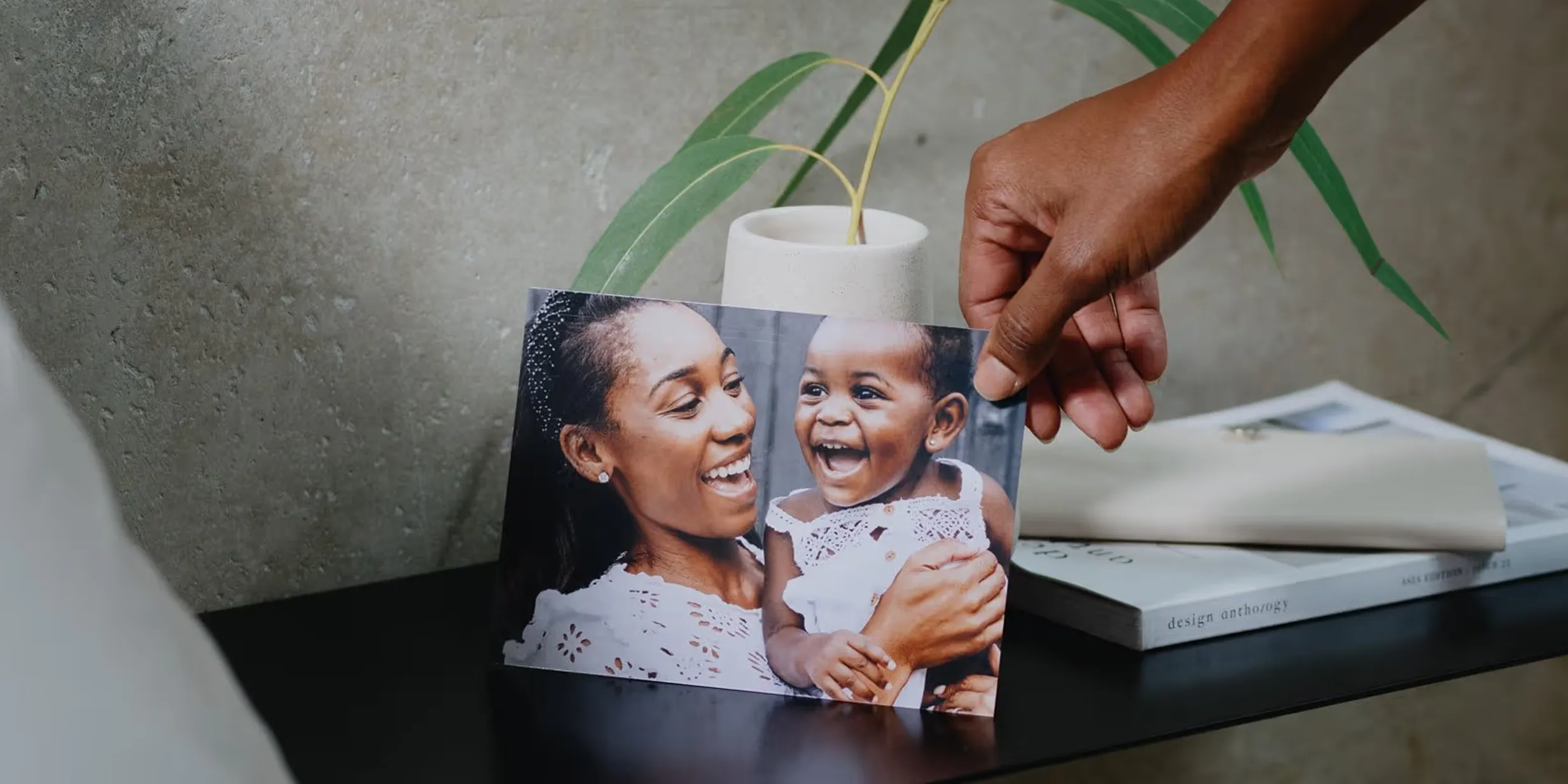
Most advice on matte or glossy photos treats the choice as a matter of taste, but it isn’t. The finish that looks best depends far more on where the print will end up and what the light is like there than on personal style. A glossy print that looks stunning in your hand can turn into a sheet of reflected window on the wall. This guide compares the two finishes plainly, covering glare, fingerprints and colour, and gives you a simple way to decide.
The short answer
Choose by the destination, not the photo. Here’s the rule of thumb: anything going behind glass should be matte, because glass already reflects light and gloss underneath doubles the glare. Gloss is the better choice for prints that stay in the open, in good, even light, such as on a fridge, a pinboard, a shelf or in someone’s hands. If you’re unsure where a print will end up, matte is the safer choice.

Prints worth handling
What does a matte finish give you?
Matte paper scatters light instead of bouncing it back, so you can see the image from almost any angle and in almost any lighting, whether that’s a bright room, spotlights or a window. Colours look accurate but softer, and contrast is gentler, which makes matte forgiving. Slight blur, low-light noise and uneven skin tones are all less noticeable. The subtle texture resists fingerprints and hides light scuffs, so matte prints stay clean through plenty of handling. The trade-off is impact: deep blacks look lifted, and saturated colours lose punch.
What does a glossy finish give you?
Glossy paper has a smooth, shiny coating that reflects light, and that coating gives gloss its strengths: richer colour, deeper blacks, higher contrast and fine detail. Bright, colourful images like beaches, sunsets, festivals and kids’ parties look vivid on gloss. The same reflectivity is also its weakness. Under a ceiling light or near a window, part of the image can disappear behind glare. Gloss also picks up fingerprints and shows scratches, and soft focus or grain that matte would hide shows up on gloss.
Matte vs glossy side by side
On glare, matte wins: minimal reflection from any angle, while gloss reflects strongly under direct light and near windows. The same goes for fingerprints: matte resists them well, gloss shows them immediately. Colour depth: gloss pulls ahead with richer tones, deeper blacks. For handling, matte hides scuffs and copes with being passed around; gloss shows every scratch and smudge.
Framing is the point that matters more than most people expect. Behind glass, gloss doubles the glare, and a glossy print pressed flat against the glass can stick to it over time, particularly in humid rooms, and be damaged when you remove it. If you do frame gloss, use a mount so print and glass don’t touch.

Frame your moments
Which finish should you choose for framing, albums and gifts?
For framed prints on the wall, choose matte, and think about the room as well as the photo. A hallway with a single overhead bulb or a living room with a big window makes gloss hard to see. For unframed prints on display, gloss works well in soft, even light. A fridge door, pinboard or photo wall in a dim corner shows off gloss’s colour without much glare; if the same wall faces a window, go matte instead.
For albums and shoeboxes, matte is the better choice. These prints get picked up, flicked through and passed around, and matte copes far better with fingers. With gifts, think about where they’ll go rather than who they’re for: a single print someone will frame should be matte; a stack of bright holiday snaps for a friend’s fridge suits gloss. Black and white photos usually suit matte, which gives them a classic textured look; if your image is dark or low in contrast, gloss can help it hold detail in the shadows.
Where do lustre and satin fit in?
Some labs offer finishes between the two, usually called lustre, satin or semi-gloss. They have a slight sheen and a fine texture, giving more colour depth than matte with much less glare and fewer fingerprints than full gloss, which is why many professional photographers use them. For most everyday prints, matte and gloss cover every situation that matters.
What does Popsa print on?
Popsa Photo Prints are printed on premium 200gsm paper, with a gloss finish as standard and an upgrade to matte available when you order. If your prints are heading into frames, make the switch. Prints come in four sizes: Small (6x4”), Medium (7x5”), Large (8x6”, about A5) and Extra Large (12x8”, about A4). You can add white or coloured borders and captions, and Popsa automatically picks landscape or portrait for each photo. If you’re not sure which size to go for, our guide to Photo Print sizes explains what each one is best for, and when you’re ready, you can create your Photo Prints with Popsa in just a few minutes from your phone.
A carregar…
Perguntas frequentes
Are glossy photos better quality than matte?
Do matte or glossy prints last longer?
Should I frame a glossy print?
Which finish is best for a photo wall?
Does the same choice apply to Photo Books?
Transferir a aplicação
Descubra memórias mais rapidamente com funcionalidades exclusivas, como o reconhecimento facial e álbuns inteligentes.



Artigos relacionados


1 de out de 2026∙4 min

13 de out de 2026∙6 min
6 de out de 2026∙6 min


 Estados Unidos