

Insights
10 shoulder season hotspots to book now
Millions of travellers' photos show where shoulder season is booming – from gorge towns to cave cities and hilltop strongholds
&w=96&q=75)
Bradley Grantham
Lead data scientist
1 oct. 2026∙15 min
Insights
Millions of travellers' photos show where shoulder season is booming – from gorge towns to cave cities and hilltop strongholds
Bradley Grantham
Lead data scientist
1 oct. 2026∙15 min
Words by Georgina Groom-Rietschy
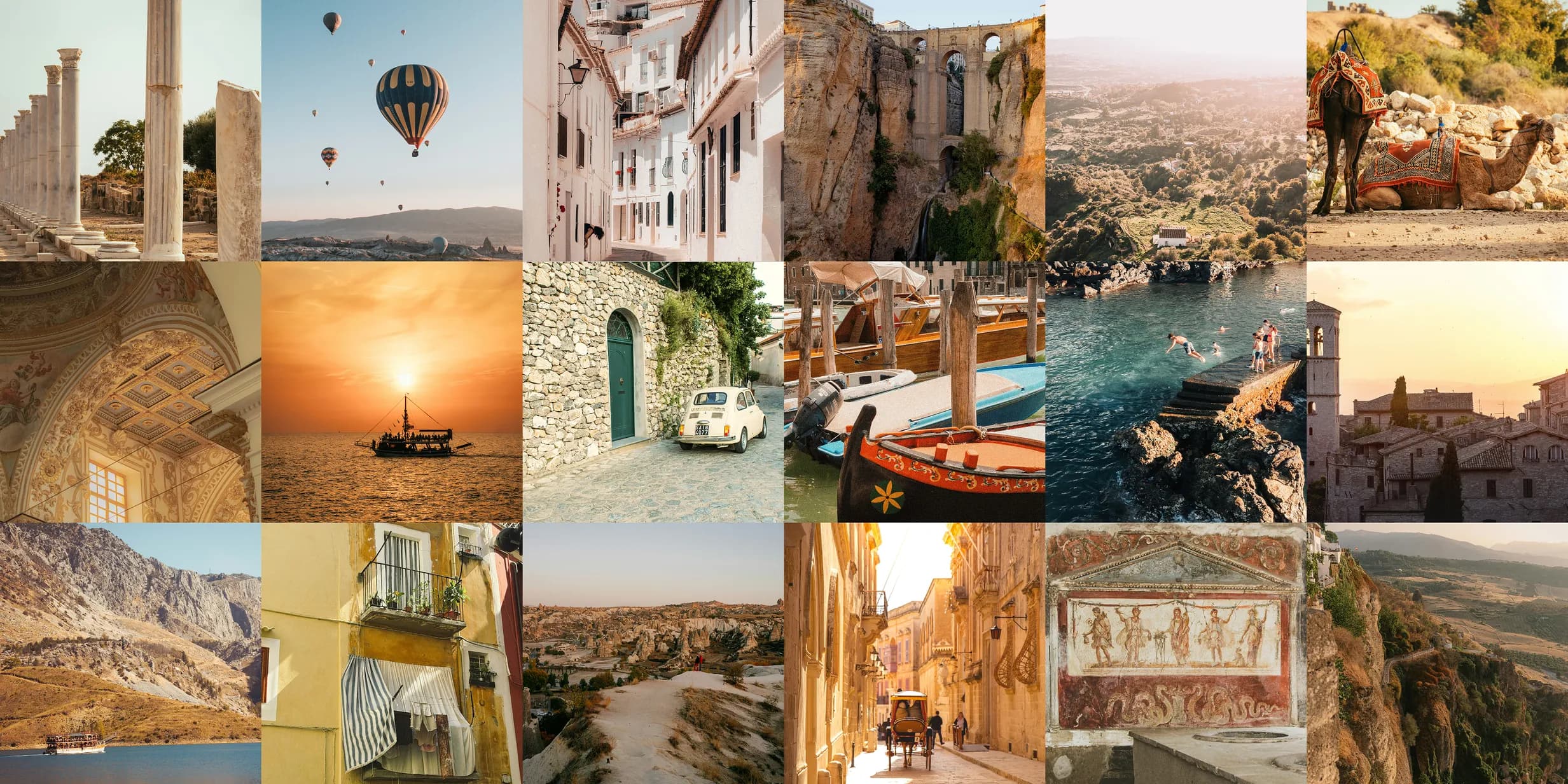
Travellers are increasingly favouring shoulder season, and we've uncovered the hottest locations to visit right now: Ronda, Mdina and Göreme. According to the European Travel Commission, 73% of Europeans intended to travel between October 2025 and March 2026, with the Mediterranean accounting for 52% of those trips. Thinner crowds and softer prices have always been part of the draw, but cooler temperatures are giving autumn getaways a renewed appeal – particularly after the record-breaking heatwaves across Europe this summer.
We analysed millions of customer photos uploaded in July and October 2025 to find the towns with a rise in footfall outside peak season. Read on to discover the towns to add to your autumn itinerary.
Curious how we calculated the photo index scores? Read the full methodology at the end of this article.
Shoulder season is the sweet spot between peak tourist season and the quieter low season, when destinations offer fewer crowds, better value and more comfortable temperatures. In Europe, it typically falls between April and June, and September and October, though timings vary by destination. The trade-off? Some hotels, restaurants and attractions may have shorter opening hours or close for the season, while cooler temperatures and changeable weather can put a dampener on beach days. Before booking, check local opening dates, transport schedules and average temperatures. Swap peak-season crowds for a slower pace with our guide to these 10 European hotspots.

Ronda, Spain. Photo: Bas van der Linden, Unsplash
Photo activity increase: 80%
Perched 740 metres above sea level in the Serranía de Ronda, between Málaga and Seville, Ronda straddles the deep El Tajo gorge, carved by the Guadalevín River. Ernest Hemingway was among the writers drawn to its rugged setting, and the town’s storied matador dynasty inspired the bullfighter hero in The Sun Also Rises. The 18th-century Plaza de Toros de Ronda, one of Spain’s oldest bullrings, recently featured in Netflix’s adaptation of Agatha Christie’s Seven Dials. October temperatures around 20C make the whitewashed streets easier to explore. Bag a table at no-frills Bar Siempre Igual to dine alongside locals on traditional tapas such as boquerones, tortilla and jamón.

Side, Turkey. Photos: Kub Liz, Unsplash

Photo activity increase: 41%
The Turkish Riviera is favoured for its turquoise coastline and mild climate, but the historic port town of Side has plenty to offer beyond the beach. Start in the old town, where early morning light catches the ancient ruins, then explore Roman landmarks including the Temple of Apollo and the amphitheatre. Unlike many of its resort-town neighbours, Side has plenty of restaurants and bars open year-round, making it a lively choice outside peak season. For seafood with a view, try Zula Side or Apollonik Cafe, where colourful cushions and stone walls complement the relaxed setting. Check into Carpe Diem Boutique Hotel, where just six individually designed rooms pair linen, wood and rattan creating a pared-back retreat between beach days and sightseeing.

Assisi, Italy. Photo: Lachlan Gowen, Unsplash
Photo activity increase: 34%
October brings the Feast of Saint Francis, when pilgrims and locals fill the Unesco-listed Basilica of San Francesco. The historic hill town is the birthplace of Italy’s patron saint, and the two-level basilica is a showcase of French-Italian Gothic architecture and medieval frescoes by Giotto. The Roman Temple of Minerva sits at the heart of the town, while the hilltop Rocca Maggiore opens onto views of the Umbrian countryside. For lunch or dinner, settle in at local favourites including Le Terrazze di Properzio or Boccabuto – known for its foraged truffles and family recipes – and Ristorante Il Vicoletto, tucked beneath stone-vaulted ceilings. Explore nearby Spello, Perugia and Gubbio, or follow the wine trail to Montefalco for a taste of its bold Sagrantino reds.

Göreme, Turkey. Photo: Timur Garifov, Unsplash
Photo activity increase: 22%
Cappadocia’s postcard-perfect landscapes are at their most atmospheric in autumn, when colourful hot-air balloons drift above its striking volcanic valleys. October’s cooler temperatures are ideal for hiking through Pigeon Valley and Rose Valley, while the cave-carved Göreme Open-Air Museum reveals Byzantine churches decorated with centuries-old frescoes. For a stay that matches the setting, Yunak Evleri comprises 10 cave houses carved into the rock, with individually designed rooms furnished with antiques and handcrafted pieces, plus private patios and balconies overlooking the landscape. Finish at Lover’s Hill, where views stretch across the town and rock formations – arrive at dawn to watch the balloons rise over the pink horizon.

Mdina, Malta. Photo: Tânia Mousinho, Unsplash

Photo activity increase: 20%
Cooler October temperatures make Mdina’s streets more inviting. The medieval city, known as the Silent City, is prized for its narrow, car-free streets, while Malta’s cultural calendar keeps things lively with festivals including Defected Malta and Anjunadeep Malta. Start at the 18th-century Mdina Gate, the grand Baroque gateway that doubled as King’s Landing in HBO’s Game of Thrones, then make your way to Pjazza San Pawl and St Paul’s Cathedral. The adjacent Mdina Cathedral Museum is stunning at sunset, when the cathedral glows orange and the church bells ring across the square. For dinner, book a table at Michelin-starred De Mondion for a tasting menu centred on local ingredients, with wines from a 500-bottle list.

Pompeii, Italy. Photo: Yaopey Yong, Unsplash
Photo activity increase: 17%
Buried beneath ash and pumice when Mount Vesuvius erupted in 79 AD, Pompeii remains one of the world’s best-preserved ancient sites. Rediscovered centuries later, the Unesco-protected site is now an open-air museum, with 66 hectares of streets, homes and shops to explore, alongside everyday objects, food and plaster casts of its residents. Away from the ruins, modern Pompeii makes a convenient base for exploring the Campanian coast, with Sorrento and central Naples within easy reach. Stay at Grand Hotel Vesuvio, where Murano glass, sea views and a spa with a pool, sauna and jacuzzi offer a polished retreat after a day among the ruins.

Puerto de La Cruz, Spain. Photos: Atlantic Ambience, Pexels

Photo activity increase: 12%
Tenerife has long been a favourite for sunseekers, but October brings a quieter energy to Puerto de la Cruz. Garachico and La Laguna make worthwhile day trips, while the town itself draws visitors with its all-inclusive resorts and easygoing atmosphere. Across the island, Pico del Teide – Spain’s highest peak – provides a backdrop, with hiking trails through its volcanic landscape and the summit sometimes dusted with the season’s first snow. Book a stay at Gran Hotel Taoro, which opened in 1890 as Spain’s first luxury grand hotel and reopened in 2025 after refurbishment. Its restaurants are a destination in their own right. Elsewhere, cool off in the saltwater pools of Lago Martiánez or wander the 18th-century botanical garden, where subtropical plant species thrive in Tenerife’s distinctive microclimate.

Ravello, Italy. Photo: Afael Peier, Unsplash
Photo activity increase: 7%
Ravello features in our ranking of the most photographed spots on the Amalfi Coast, so it’s little surprise that it’s a shoulder season hotspot too. Resting above the Gulf of Salerno, the clifftop village is loved for its centuries-old villas, manicured gardens and a long-standing classical music heritage. Villa Rufolo is a particular draw, with its striking archway framing the bay and gardens cascading down the hillside, while Villa Cimbrone is a ten-minute walk from the main piazza and home to the Terrace of Infinity, where sweeping views stretch along the Amalfi Coast. Make time to explore nearby spots including the colourful Positano and Sorrento’s parasol-lined Marina Grande.

Mijas, Spain. Photo: Aleks Magnusson, Pexels

Photo: Yuliya Matuzava, Unsplash
Photo activity increase: 7%
Whitewashed houses and views across the Costa del Sol give Mijas the distinctive look of an Andalusian hill town. Calle San Sebastián is one of the village’s most photogenic streets, while the ruins of its Moorish castle open onto coastal views. Look out, too, for the 17th-century Ermita de la Virgen, carved into the rockface, and the Plaza de Toros, built in 1900. Arrive before midday to beat the tour groups, then browse the pottery stalls along Calle Málaga. For lunch, settle into Tomillo Limón, where seasonal Andalusian dishes come with a streetside terrace.

Los Cristianos, Spain. Photo: Tara Vester, Unsplash
Photo activity increase: 7%
Once a sleepy fishing village, Los Cristianos is now one of Tenerife’s more relaxed resort towns, with traditional Canarian architecture still lining its harbour. A palm-lined promenade links the beaches of Playa de los Cristianos and Playa de las Vistas with livelier Playa de las Américas. Most mornings, boats leave the harbour in search of pilot whales and dolphins, while ferries depart daily from the Port of Los Cristianos, one of Spain’s busiest passenger ports. For a glimpse of the town’s past, wander along Avenida de Suecia to Casa Sueca, a reminder of the Swedish convalescents who put Los Cristianos on the map in the 1950s.
To determine the most favoured off-season European towns, Popsa’s data science team analysed millions of photos uploaded by customers in 2025. Using location metadata, we identified images taken within the boundaries of Europe’s most visited towns and ranked them by the spike in the off season relative to peak season.
We assigned each town a percentage based on the increase in user volume from peak season to off-season, so the ranking rewards places that grow their appeal once peak season passes rather than the ones that are simply busiest overall. The result is a ranking that reflects real traveller behaviour, highlighting not just where people visit, but where they’re most inspired to capture their memories.
Replongez dans vos souvenirs en toute simplicité grâce à des fonctionnalités exclusives comme la reconnaissance faciale et les albums intelligents.



%3Agrayscale()&w=96&q=75)
Bradley Grantham
Lead data scientist
27 janv. 2026∙8 min
Bradley Grantham
Lead data scientist
15 avr. 2026∙10 min
Bradley Grantham
Lead data scientist
29 avr. 2026∙8 min


 États-Unis